
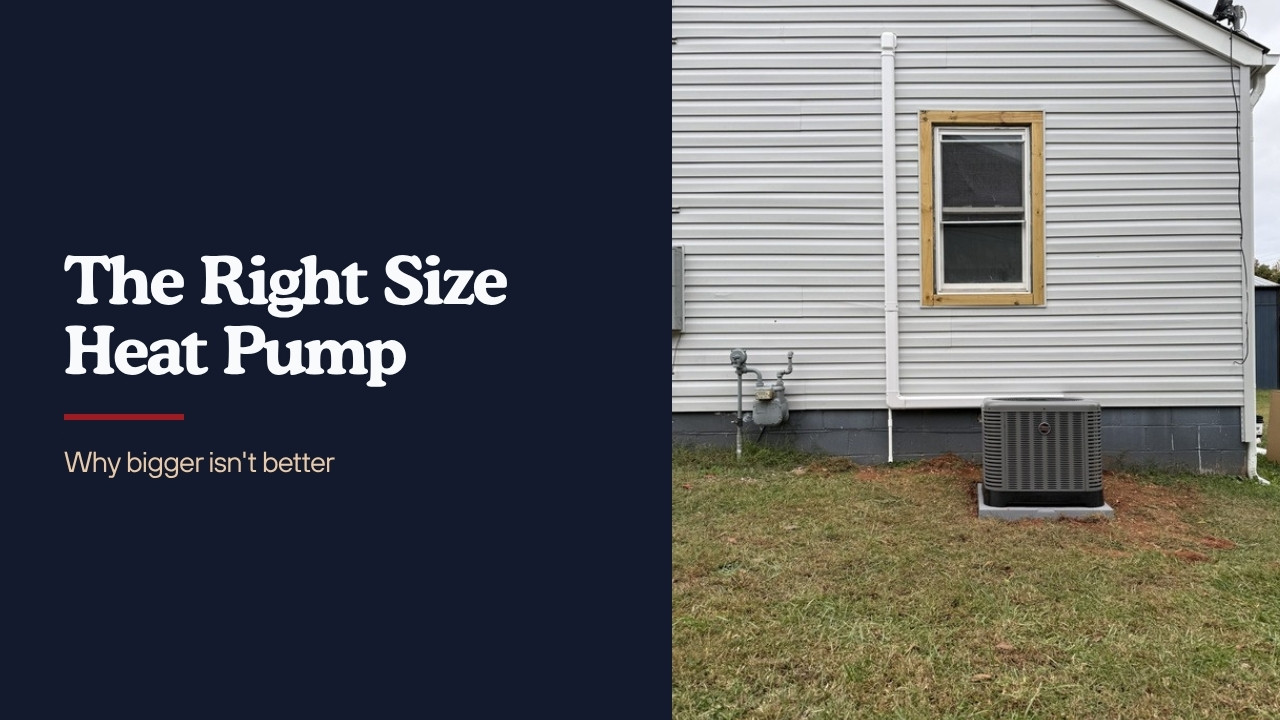
When homeowners start shopping for a heat pump, the first question is almost always "what size do I need?" — and the most common mistake is assuming the answer works like most purchases, where a little extra capacity is cheap insurance. With heat pumps, it is the opposite. An oversized system causes just as many problems as an undersized one, sometimes more. Here is how sizing actually works, and what a company should be doing before it ever quotes you a system.
Why bigger is not better
A heat pump that is too large for the house heats (or cools) the space in short, powerful bursts, then shuts off. Then on again. Then off. That pattern is called short cycling, and it is hard on equipment and comfort alike — we covered it in detail in our article on why systems start and stop constantly. The highlights:
- More wear, shorter life. Startup is the hardest moment in a compressor’s day. An oversized system racks up far more starts for the same amount of comfort.
- Uneven temperatures. Short bursts satisfy the thermostat — which measures one spot in a hallway — before the rest of the house catches up. Rooms far from the thermostat stay cold.
- Worse summer humidity control. Pulling moisture out of the air takes sustained run time. An oversized system cools the air fast and shuts down before it has dried it, which is why oversized homes feel clammy in July.
- You paid for capacity you cannot use. Bigger equipment costs more to buy and install, and the extra never earns its keep.
Why smaller is not better either
An undersized heat pump runs and runs and never quite catches up. On a heat pump, there is an extra penalty most people do not see coming: when the system cannot hold the setpoint on its own, the thermostat quietly brings in the electric backup heat — the most expensive heat in the house. An undersized heat pump can spend half the winter leaning on its auxiliary heat, and the electric bill tells the story. The house feels fine. The bill does not.
Square footage alone cannot answer the question
You will find plenty of charts online that map square footage straight to equipment size. Here is why we do not quote from them: two houses with identical square footage can need very different systems. What actually determines the load:
- Insulation and air sealing. A tight 1990s house and a drafty farmhouse of the same size are different jobs entirely.
- Windows. How many, how old, facing which direction. A wall of west-facing glass changes the math.
- Ceiling height and layout. Volume matters, not just floor area — and an open two-story great room behaves differently than the same footage in closed rooms.
- Ductwork. Leaky or undersized ducts waste a portion of everything the equipment produces. Sizing around bad ducts locks the waste in.
- Orientation and shade. Sun exposure, tree cover, and which way the house faces.
- Local climate. Our foothills winters are real but moderate — a well-chosen heat pump handles them — and elevation varies enough across Burke, Catawba, McDowell, Caldwell, and Rutherford counties that the same floor plan can carry a different load in Marion than it does in Hickory.
The industry-standard way to account for all of that is a load calculation — the method HVAC contractors know as Manual J, published by the Air Conditioning Contractors of America. It is arithmetic, not guesswork: the house’s measurements, construction, windows, and climate go in; the heating and cooling load comes out. The equipment is then chosen to match the load, not the other way around.
Replacing a system? Do not just match the old label
The fastest way to size a replacement is to read the nameplate on the old unit and order the same. It is also how sizing mistakes get inherited for decades. Before matching the old size, it is worth asking:
- Was the old unit sized right in the first place? If the house never cooled evenly or felt clammy in summer, copying the old size copies the problem.
- Has the house changed? New windows, added insulation, a finished bonus room, an addition — each one moves the load, in either direction.
- Is the heating strategy changing? Moving from an old furnace to a heat pump, or adding a dual-fuel setup, changes what the equipment needs to do on the coldest nights. Our guide on furnaces versus heat pumps covers that decision.
And to be fair the other way: if your current system has kept the house comfortable for years, cycles normally, and handles summer humidity, its size is probably close to right. That is useful information, and a good contractor will treat it as part of the evidence — then verify it rather than assume it.
One size question, several system answers
Sizing is not only "how much," it is "arranged how." Some houses are best served by one central system. Others — especially homes with additions, bonus rooms over garages, or no existing ductwork — do better with a multi-zone mini-split, where each area gets its own right-sized head instead of one big unit fighting the whole floor plan. Mini-splits have also gotten very good in the cold — see our piece on mini-splits in a North Carolina winter. The right answer depends on the house, which is exactly why the measuring comes first.
What to expect when we size your home
When we quote a heat pump, the visit looks like this: we walk the house, measure, look at the insulation and the windows, inspect the ductwork, and ask about the rooms that have never been comfortable — those complaints are data. Then we run the numbers and explain what we found in plain language: here is the load, here is the equipment that matches it, here is why. We install Goodman, Ruud, and Bosch systems and service every brand, and new installations carry a one-year labor and ten-year parts warranty.
If another company quotes you a size over the phone from square footage alone, that is worth a second opinion — not because the number is always wrong, but because nobody can know it is right without looking at the house.
Southern Summit HVAC is a veteran-owned heating and cooling company serving Burke, Catawba, McDowell, Caldwell, and Rutherford counties, including Hickory, Morganton, Lenoir, and Marion. Thinking about a new heat pump, or stuck with one that has never heated evenly? Call or text (828) 308-0928 and we will size it from the house, not a chart. NC License #33148.
Need a hand with your system?
Southern Summit Heating & Cooling is a veteran-owned, licensed heating and cooling company (NC License #33148) based in Hickory, serving Burke, Catawba, Caldwell, McDowell and Rutherford counties. Estimates are free and you get one of us on the phone — not a call center.
Call or Text (828) 308-0928