
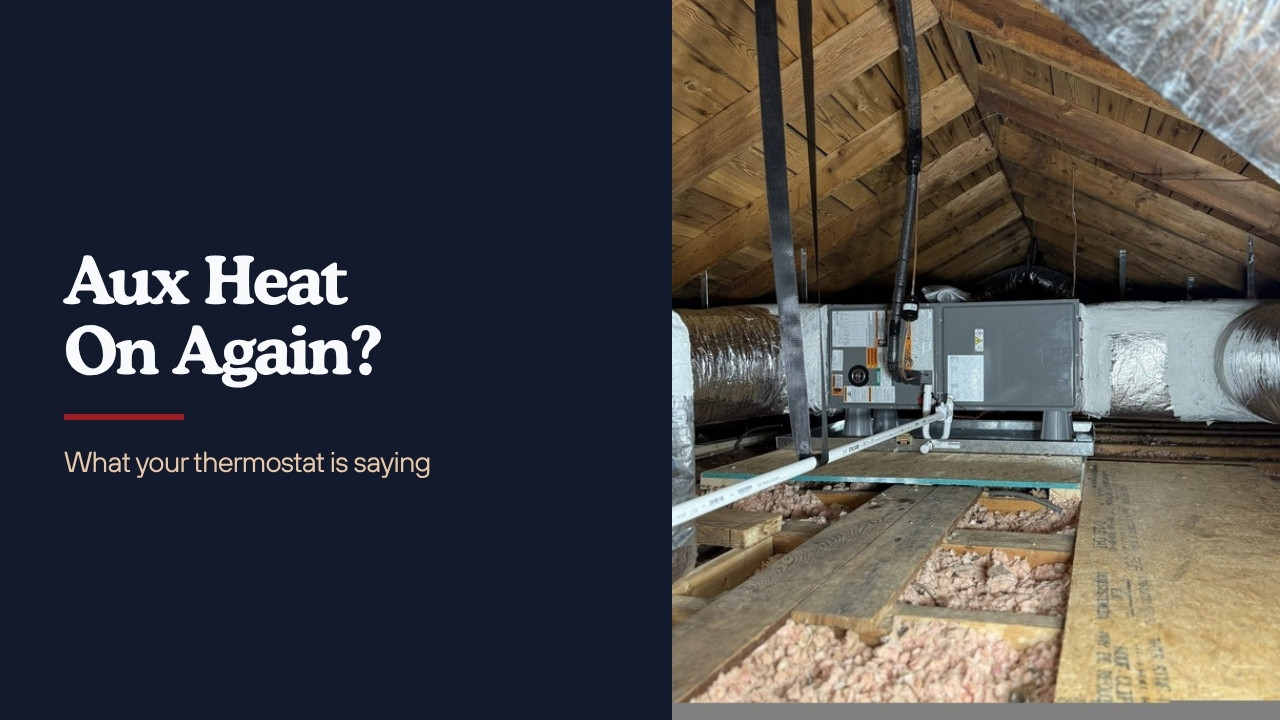
It is a cold morning, you glance at the thermostat, and there it is: AUX HEAT. Maybe it has been showing up a lot lately. Maybe you have also noticed the setting right next to it labeled "Emergency Heat" and wondered if you are supposed to be using it. If you heat your home with a heat pump — as many homes in Burke, Catawba, McDowell, Caldwell, and Rutherford counties do — this article will tell you exactly what those words mean, when they are nothing to worry about, and when they are your system asking for help.
What auxiliary heat actually is
A heat pump heats your home by moving heat from the outdoor air to the indoor air. Even cold air contains heat, and a healthy heat pump is remarkably good at collecting it. But as the outdoor temperature drops, there is less heat available to move, and the heat pump’s output gradually falls — right as your house needs more.
Auxiliary heat is the backup that covers that gap. In most heat pump systems around here, it is a set of electric heating elements inside your indoor air handler — think of a very large, very powerful version of the coils in a toaster. In a dual-fuel setup, the backup is a gas furnace instead; we explain how that pairing works in our dual-fuel heat pump guide.
The key point: auxiliary heat is automatic. Your thermostat decides when the heat pump needs the assist, turns the backup on, and turns it off when the heat pump can handle the load again. When the indicator lights up, the system is doing what it was designed to do.
When aux heat is completely normal
- Very cold nights. When temperatures really drop, most heat pumps need some help holding the setpoint. Seeing aux heat during a cold snap is expected, not a defect.
- Big thermostat jumps. Ask for 72 when the house is sitting at 64 and the thermostat will call in the backup to close that gap quickly. The system is not broken — it is responding to the size of the request.
- During defrost. In winter, every heat pump periodically reverses itself for a few minutes to melt frost off the outdoor coil. While it does, the auxiliary heat usually runs so the air at your vents does not turn cold. If you have ever seen your outdoor unit steaming on a frosty morning, that is this — we wrote a whole piece on defrost mode.
When aux heat is telling you something is wrong
Backup heat is the most expensive way your system makes warm air. Electric heating elements use far more electricity than the heat pump itself for the same amount of warmth. That is fine as a supplement on cold nights. It is a problem as a lifestyle. Call it what it is — a warning sign — when:
- Aux heat runs in mild weather. If the backup is on during an ordinary fall afternoon, the heat pump is not carrying the load it should.
- Aux heat runs constantly. Hours at a stretch, day after day, even when it is not especially cold.
- The heat pump never seems to run without it. A heat pump that always needs its helper may have a refrigerant leak, a failing component, or an airflow problem. Our heat pump troubleshooting guide walks through what to check, and our article on refrigerant leak warning signs covers the most common hidden culprit.
- Your winter electric bill jumps with no change in weather or habits. Runaway backup heat is one of the first places we look.
Emergency heat is a different thing — and it is not for cold days
Here is the one that trips people up. "Emergency Heat" (often EM HEAT on the thermostat) is not a turbo button for extra warmth, and switching it on because the forecast looks brutal will not heat your home better. It does the opposite of what most people expect.
Emergency heat is a manual override that shuts the heat pump off entirely and runs your home on backup heat alone. It exists for one situation: the heat pump itself is broken or damaged — say a fan motor has failed, or the outdoor unit has taken physical damage — and you need heat while you wait for the repair. Running on emergency heat keeps a damaged heat pump from hurting itself further. It also costs noticeably more to run, because the most expensive heat source in the system is now the only one working.
Two simple rules cover it:
- If the heat pump is running and the house is warm, leave the switch alone — even on the coldest night of the year. The system will bring in auxiliary heat on its own when it needs it.
- If the heat pump is clearly not working — the outdoor unit will not run, it is making grinding noises, or a technician told you to — switch to emergency heat, and get the repair scheduled.
How to keep aux heat from running more than it should
- Set it and leave it. Big setpoint swings are the most common homeowner-caused trigger. Pick a comfortable temperature and make small moves, a degree or two at a time.
- Be careful with aggressive setback schedules. Dropping the house way down overnight and asking for a fast recovery at 6 a.m. can hand the morning shift entirely to the electric elements. A milder setback often costs less overall on a heat pump.
- Change your filter. A starved blower moves less air across the coil, the heat pump falls behind, and the backup fills in. It is the cheapest fix on this list — our filter guide shows you how to do it right.
- Keep the outdoor unit clear. Leaves, snow drifts, and shrubs crowding the unit choke off the air the heat pump collects heat from. Give it room to breathe. Our winter prep checklist covers the rest.
The honest bottom line
If your aux heat indicator comes on during a cold snap and goes back off, you do not need us. That is the system working. Save the call — and the invoice — for when the pattern changes: backup heat in mild weather, backup heat all day, a bill that does not match the thermometer, or a heat pump that will not run at all.
When that happens, we will figure out why the heat pump is not pulling its weight and give you a straight answer about what it needs — the same approach that has earned us dozens of five-star reviews across the foothills.
Southern Summit HVAC is a veteran-owned heating and cooling company serving Burke, Catawba, McDowell, Caldwell, and Rutherford counties, including Hickory, Morganton, Lenoir, and Marion. If your thermostat is showing aux heat more than it should — or your heat pump has quit and you are running on emergency heat right now — call or text (828) 308-0928. NC License #33148.
Need a hand with your system?
Southern Summit Heating & Cooling is a veteran-owned, licensed heating and cooling company (NC License #33148) based in Hickory, serving Burke, Catawba, Caldwell, McDowell and Rutherford counties. Estimates are free and you get one of us on the phone — not a call center.
Call or Text (828) 308-0928