
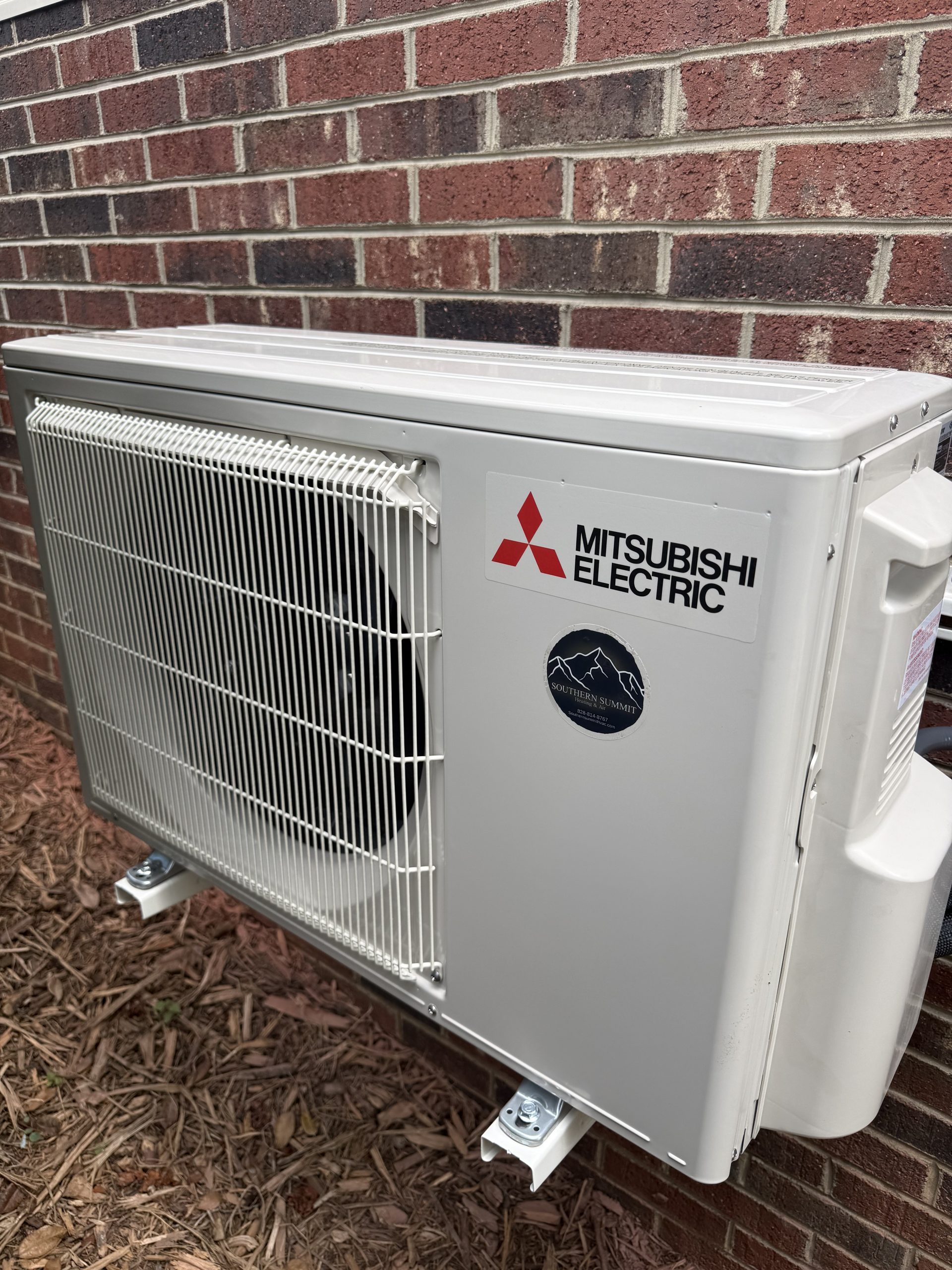
Mini-splits earned their reputation in the South as cooling machines — quiet, efficient, no ductwork needed. So every fall, we hear the same doubt from homeowners around Hickory, Morganton, Lenoir, and Marion: ‘Sure, it cools great. But can it actually keep up in January?’
It’s a fair question, and the honest answer is: yes, with two conditions attached — the right equipment and the right expectations. This article walks through how mini-splits heat, where the old reputation for weak winter performance came from, what a western North Carolina winter actually asks of one, and the situations where we’d steer you toward something else instead. If you’re weighing heating options for your home, a garage, or an addition, call or text us at (828) 308-0928 and we’ll talk through your specific setup.
A mini-split is a heat pump — and that’s the whole story
A ductless mini-split doesn’t burn anything to make heat. Like any heat pump, it moves heat — in summer it pulls heat out of your rooms and dumps it outside, and in winter it runs the same process in reverse, extracting heat from the outdoor air and delivering it inside. It sounds backwards, but even cold winter air contains heat energy, and modern compressor technology has gotten remarkably good at harvesting it.
That matters for the winter question, because it means a mini-split’s heating ability depends on how cold it gets outside. The colder the air, the harder the unit works to extract heat from it. The question isn’t whether a mini-split can heat — it’s whether it can heat your space, in our climate, on the coldest nights we actually get.
Where the ‘they quit in the cold’ reputation came from
It came from older equipment, and it was once deserved. Early-generation units lost a large share of their heating capacity as temperatures dropped toward freezing, and in genuinely cold weather some would struggle to keep a room comfortable at all. People who had one of those units — or heard about one — wrote off the whole category for winter use.
The equipment has moved on. Today’s cold-climate mini-splits use variable-speed compressors and smarter refrigerant management to keep producing meaningful heat at temperatures well below what a western North Carolina winter typically delivers. Units are rated by their manufacturers for continued heating output at specific low temperatures, and those ratings vary a lot between models and tiers — which is exactly the kind of thing to check before you buy, not after. When we quote a mini-split for heating, we match the model’s published low-temperature performance to the job. Ask whoever quotes yours to do the same, and to show you the numbers for the specific model — not the brochure line for the brand.
What a winter here actually asks of it
Our area sees plenty of nights below freezing, stretches of cold rain, and the occasional single-digit snap — cold, but nothing like the far-northern winters these systems are now routinely installed in. For the overwhelming majority of nights in Burke, Catawba, Caldwell, McDowell, and Rutherford counties, a properly sized modern mini-split doesn’t break a sweat.
Two winter behaviors are worth knowing about in advance, so they don’t surprise you:
- Defrost cycles. In cold, damp weather the outdoor unit will frost up and periodically pause to melt it off — you may see steam and feel a few minutes of cooler air. That’s normal for every heat pump. We explain the whole process in our guide to heat pump defrost mode.
- Gentler supply air than a furnace. A gas furnace blasts hot air in short bursts. A mini-split delivers steadier, milder warm air over longer run times. The room ends up just as warm, but the air from the unit doesn’t feel like a campfire. Homeowners switching from gas sometimes mistake that for weak performance in the first week. It isn’t — it’s how the technology works, and it’s also why the comfort tends to be more even.
Where mini-splits genuinely shine in winter
- Spaces with no ductwork: additions, bonus rooms, garages, workshops, finished basements, older homes that never had ducts. Running new ductwork to one room is expensive and invasive; a mini-split needs a small hole in the wall.
- Rooms the main system never handled well. That bedroom over the garage that’s always cold — a dedicated mini-split head solves it without touching the rest of the house.
- Zoned living. Heat the rooms you use, when you use them, instead of the whole house to one temperature. A multi-zone system can run several indoor heads off one outdoor unit, each with its own setting.
- Efficiency. Because a heat pump moves heat rather than making it, the heat it delivers costs less energy than electric resistance heating — baseboards, wall heaters, space heaters — by a wide margin. If you’re currently heating a room with a plug-in space heater all winter, a mini-split is a meaningful efficiency upgrade.
Where we’d tell you honestly to consider something else
A mini-split is not always the answer, and we’d rather lose the sale than put the wrong equipment on your house:
- A whole house that already has good ductwork. If your ducts are in decent shape, a central heat pump or a dual-fuel system usually serves the whole home better than hanging a head in every room. We compared the options in Central AC or Ductless Mini-Split: Which One Fits Your Home? — the same logic applies to heating.
- A home that regularly needs serious backup heat. Mini-splits generally don’t have the built-in auxiliary heat strips that central heat pumps carry. If your situation calls for a big heating safety margin, that belongs in the system design from day one.
- A drafty, poorly insulated space. No heating equipment overcomes a room that leaks heat as fast as it’s delivered. Sometimes the right first dollar goes into the building, not the equipment — and we’ll say so when that’s what we see.
Three things that decide whether yours will perform this winter
- Sizing. An undersized unit runs flat-out and still falls behind on cold nights; an oversized one short-cycles and heats unevenly. Proper sizing against the room’s actual heat loss is most of the job. If a quote arrives without anyone measuring or asking about your space, be suspicious.
- Installation quality. Refrigerant line length and routing, mounting height, outdoor unit placement out of roof runoff and drifting leaves — the installation details decide how the unit handles winter as much as the equipment tier does.
- A clean unit. Clogged filters and a dirty coil choke winter performance exactly when you need it most. Washing the filters takes ten minutes, and fall is the time to do it — our mini-split maintenance guide walks through it step by step. Do it this weekend, before the first real cold arrives.
The bottom line
Can a mini-split heat your home through a North Carolina winter? A modern, correctly sized, well-installed one — yes, comfortably, and efficiently. The failures people hear about trace back to old equipment, bad sizing, or asking one small head to carry a whole leaky house. Those are avoidable problems, and avoiding them is our job.
Thinking about one before winter sets in?
Southern Summit HVAC is a veteran-owned heating and cooling company serving Hickory, Morganton, Lenoir, Marion, and homeowners throughout Burke, Catawba, Caldwell, McDowell, and Rutherford counties. We install and service ductless systems of every brand, and we’ll give you a straight recommendation for your space — including ‘you don’t need this’ when you don’t. Fall installs mean you’re not waiting on equipment when the first cold snap hits.
Call or text (828) 308-0928, or request a visit online. Southern Summit Heating & Cooling LLC is a licensed North Carolina HVAC contractor, license #33148.
Need a hand with your system?
Southern Summit Heating & Cooling is a veteran-owned, licensed heating and cooling company (NC License #33148) based in Hickory, serving Burke, Catawba, Caldwell, McDowell and Rutherford counties. Estimates are free and you get one of us on the phone — not a call center.
Call or Text (828) 308-0928