
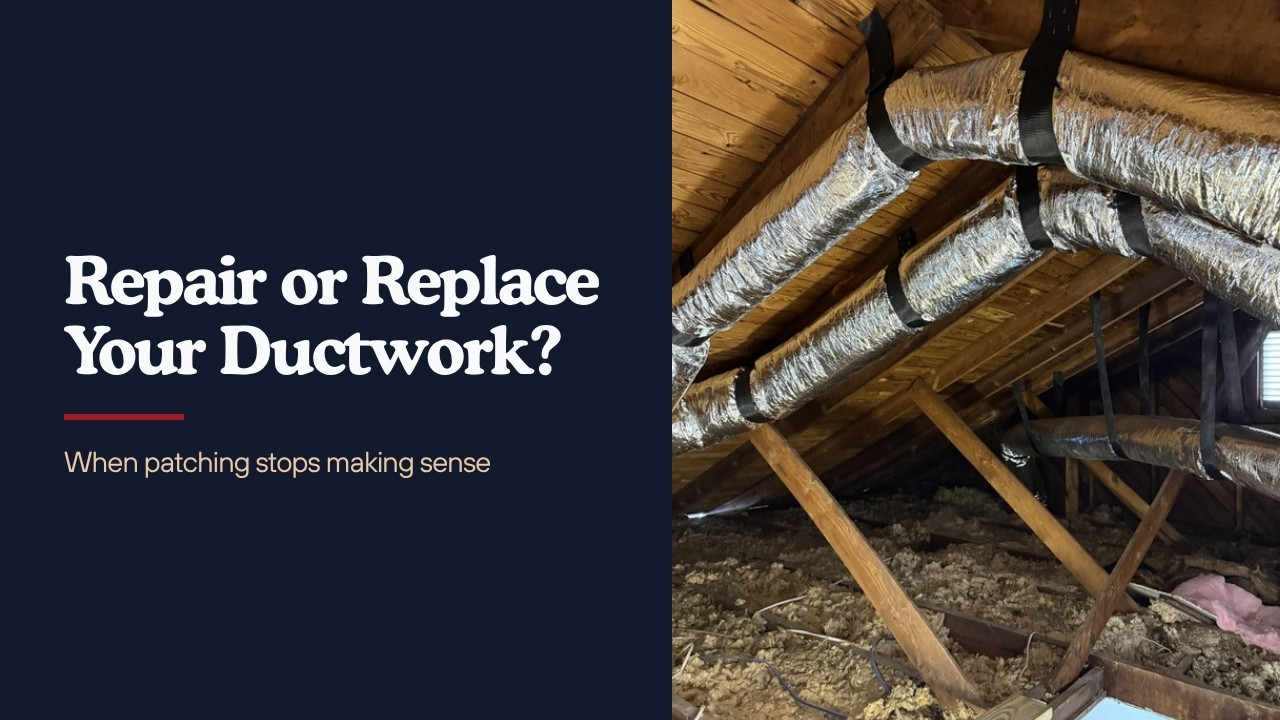
Most homeowners never think about their ductwork, and honestly, that is how it should be. Ducts are supposed to be the boring part of the system — sheet metal and flex duct quietly carrying air where it needs to go, for decades, without complaint.
But ductwork does wear out. And when it does, homeowners usually end up replacing the expensive equipment — the furnace, the heat pump, the air handler — while the worn-out ducts that caused half their comfort problems stay right where they are, choking the brand-new system the same way they choked the old one.
So how do you know when ducts can be repaired and sealed, and when the right answer is replacing them? Here is how we think about it.
Repair first: most duct problems don’t need replacement
Let’s start with the truth that saves you money: most ductwork problems are repairable. A disconnected joint in the crawlspace, a crushed section of flex duct, a few leaky connections, torn insulation on one run — those are repairs. We find the damaged spots, reconnect and seal them, and the system goes back to doing its job. If your main complaints are uneven rooms and high bills, start with our guide to leaky ductwork and duct sealing, because sealing fixes a large share of what people assume is a dying system.
A house with five-year-old ducts and one crushed run does not need new ductwork. Anyone who tells you otherwise is selling, not diagnosing.
When repair stops making sense
That said, there is a point where patching old ducts is like patching a garden hose that splits somewhere new every summer. Here are the signs that replacement deserves a real conversation.
1. The duct material itself has failed
Flex duct has an inner liner, a layer of insulation, and an outer jacket. Age, heat, and crawlspace conditions eventually make the materials brittle — the liner sags and tears, the jacket cracks, and the insulation slumps to the bottom of each run. When the material is failing everywhere at once, every repair is temporary by definition. The same goes for old metal duct whose seams have let go throughout the system or whose insulation wrap has fallen away.
2. You seal it, and the problems come back
If your ducts have been sealed or repaired before and the symptoms keep returning — uneven rooms, weak airflow, dust, bills that stay high — the system is telling you something. There is a point where the next repair costs good money to buy a short reprieve, and putting that money toward ducts that will simply work is the better deal.
3. The duct system was never designed right in the first place
This one is common in older homes around western North Carolina, and no amount of sealing fixes it. Undersized trunks, long snaking flex runs, too few return vents, additions that were tapped onto a system never sized for them — these are design problems. The ducts can be perfectly intact and still unable to deliver the airflow each room needs. The classic symptom is a bedroom at the end of the run that has never been comfortable in any season, no matter what the thermostat says. We wrote about why rooms end up uneven in our ductwork guide, but when the cause is design rather than damage, replacement — or rerouting and resizing part of the system — is the honest fix.
4. Your equipment is new, but the performance isn’t
If you have replaced the furnace or heat pump and the house somehow doesn’t feel much better, the ducts are the prime suspect. New equipment can only deliver what the duct system can carry. This is why we look at ductwork before recommending equipment: pairing a new system with failing ducts wastes the money you just spent. If you are planning a furnace replacement or sizing out a new heat pump, the state of the ducts should be part of that decision, not an afterthought.
5. Rooms far from the unit barely get air
Stand at the farthest vent in the house while the system runs. If the air barely moves your hand while the vents near the unit blast, the air is escaping or losing pressure along the way — through leaks, crushed runs, or undersized duct. A one-room airflow problem is usually a repair. Weak delivery across half the house, in a system that has already been patched, points bigger.
What replacement actually involves
Replacing ductwork is less disruptive than most people expect, because ducts live in the parts of the house you don’t — the crawlspace and the attic. There is no tearing open walls in a typical job. The old runs come out, the new system goes in sized to the equipment and the rooms it serves, joints are sealed as they are built, and the insulation on the new runs is continuous instead of crumbling.
Done right, the difference is one you feel the first day: rooms that get real airflow for the first time, a system that stops running marathon cycles to hit the setpoint, and supply air that arrives at the temperature the equipment made it. A furnace or heat pump that no longer fights its own ductwork also runs shorter cycles, which is easier on every part in it — something we covered in our article on short cycling.
The honest middle ground: partial replacement
Here is something that gets skipped in a lot of sales pitches: replacement is not all-or-nothing. Plenty of systems have a sound metal trunk with failing flex branches, or one bad zone tacked onto an otherwise decent layout. In those cases, replacing the failed sections and sealing the rest delivers most of the benefit at a fraction of the disruption. A two-year-old duct system does not need what a thirty-year-old system needs — and we will tell you which one you have.
How to get a straight answer
Any recommendation to replace ductwork should come with evidence you can see yourself. When we inspect a duct system, we show you photos of what is in your crawlspace or attic — the actual disconnected joint, the actual slumped insulation, the actual kinked run. You should never be asked to replace something you have not been shown.
And the recommendation should match the findings: repair and seal when the system is fundamentally sound, replace the sections that have failed when the failure is local, and replace the system when the material or the design is past saving. We give you our recommendation based on your home and your budget, not a script.
Wondering about the ducts under your house?
Southern Summit HVAC installs, repairs, and replaces residential ductwork across Burke, Catawba, McDowell, Caldwell, and Rutherford counties. We are a veteran-owned company — two guys who treat every job like it is our own home, show you exactly what we found, and help you decide based on what the ducts actually need.
If your rooms have never heated or cooled evenly, or your ducts have been patched one time too many, call us at (828) 308-0928 and we will take a look. Southern Summit Heating & Cooling LLC — NC License #33148.
Need a hand with your system?
Southern Summit Heating & Cooling is a veteran-owned, licensed heating and cooling company (NC License #33148) based in Hickory, serving Burke, Catawba, Caldwell, McDowell and Rutherford counties. Estimates are free and you get one of us on the phone — not a call center.
Call or Text (828) 308-0928