
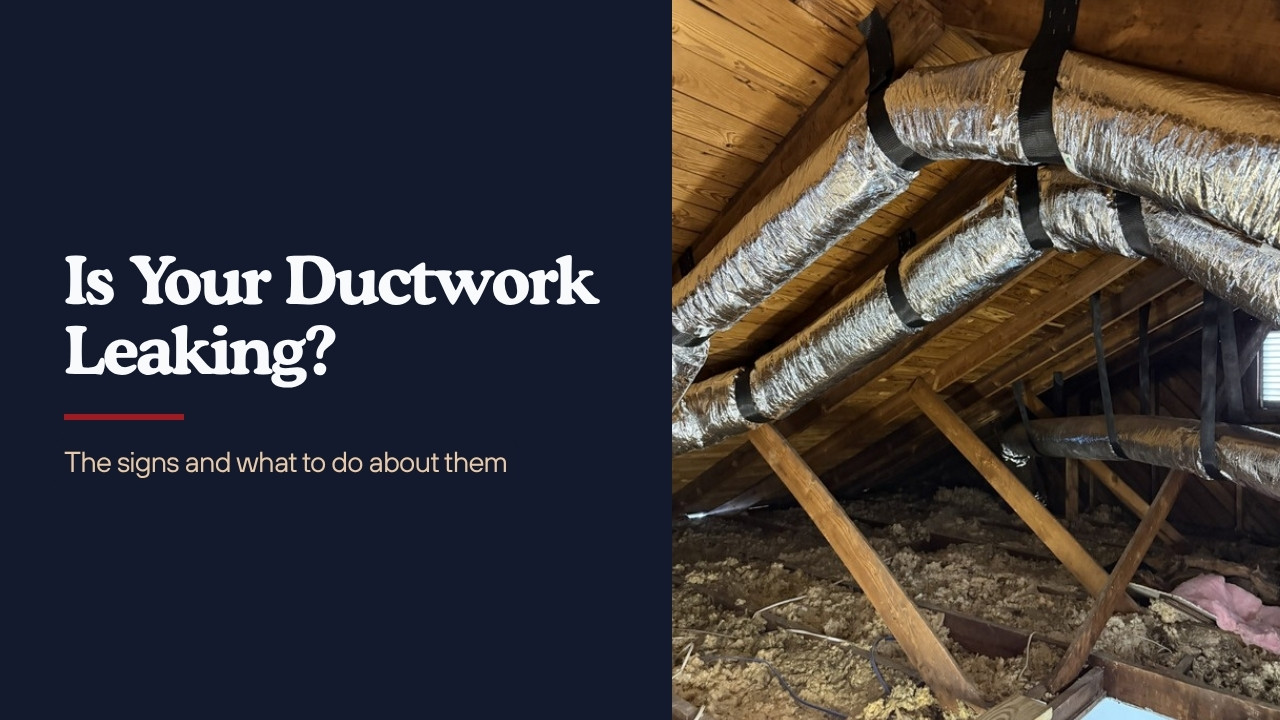
Your ductwork is the one part of your heating and cooling system you never look at. It runs through the attic or under the house in the crawlspace, and as long as air comes out of the vents, most people assume it is fine. But duct problems are some of the most common issues we find in Foothills homes — and because the symptoms show up as comfort problems and high bills rather than as an obvious breakdown, they can go unnoticed for years while you pay for heat that never reaches a bedroom.
What leaky ducts actually do
Your furnace or heat pump heats air, and the ducts carry that air to your rooms. When a duct joint has pulled loose, a flex duct has torn, or a section has been crushed, some of that heated air spills into the attic or crawlspace instead. You paid to heat it; now it is warming the underside of your roof.
It works in reverse, too. The return side of the system — the ducts that pull air back to be heated — can suck in attic or crawlspace air through the same gaps. That unconditioned air is cold in winter, and it carries dust, humidity, and whatever else lives under the house with it.
The signs worth paying attention to
None of these proves your ducts are leaking, but each one is a reason to look closer:
- One or two rooms never keep up. The bedroom at the end of the run is always colder in winter and warmer in summer than the rest of the house.
- Your bills climb even though the equipment checks out. If the system itself is running well and the bills still do not make sense, the air may be going somewhere you are not living.
- The house is dusty no matter how often you clean. Return-side leaks pull unfiltered air into the system and spread it through the house.
- You hear whistling or flapping when the system runs. Air forcing its way through gaps makes noise.
- The system runs long and struggles on cold nights it used to handle without trouble.
Winter is when duct leaks cost you the most, because the temperature difference between the heated air and the crawlspace it leaks into is at its largest. A leak you did not notice in April works against you every hour the heat runs in January.
What you can check yourself, today
You do not need tools for a first look, and we would rather you look than wonder:
- Walk the visible runs. If you can safely get into the crawlspace or attic, look at the flex ducts. Are any sagging, kinked, crushed, or hanging loose? Is anything visibly disconnected, with insulation blowing around near it?
- Feel around the joints while the heat runs. A leak big enough to matter is often a leak you can feel with your hand.
- Look at your registers and returns. Weak airflow at one vent while others blow hard points toward a problem in that branch.
- Check your filter. A clogged filter chokes airflow and mimics duct problems. It is the two-minute check that solves more comfort complaints than anything else — here is how to change your HVAC filter if it has been a while.
One honest caution: if getting under the house or into the attic means balancing on joists or crawling past wiring, skip it and let us look. No energy savings are worth a fall.
What duct repair involves
When we inspect ductwork, we are looking at the whole path the air takes — supply and return — and the fix depends on what we find:
- Reconnecting and securing joints that have pulled apart. Flex duct connections that were taped decades ago let go over time. They get properly fastened and sealed, not just taped back.
- Replacing damaged sections. A crushed or torn flex duct does not get patched into service — the bad section comes out and new duct goes in.
- Sealing the gaps at joints and boots where ducts meet the floor or ceiling, so the air stays in the system all the way to the room.
- Supporting sagging runs. A flex duct that droops between supports chokes its own airflow even without a leak.
Sometimes the honest answer is that the ductwork is worth repairing, and sometimes it is not. A system of old, undersized, or badly routed ducts can reach the point where replacing sections — or the whole run — makes more sense than chasing leaks one at a time. If that is what we find, we will show you why, and we will tell you if a repair gets you most of the benefit for less. Duct and vent installation and repair are normal work for us; you can read more on our ductwork and air quality services page.
Do not forget the insulation on the ducts themselves
A duct can be perfectly sealed and still lose heat. Ducts that run through unconditioned spaces — attics and crawlspaces — rely on their insulation wrap to keep the air inside warm on the trip to your rooms. Over the years that wrap gets torn by critters, flattened by stored boxes, or soaked by a past roof or plumbing leak, and wet or crushed insulation stops doing its job. While you are looking at the visible runs, look at the jacket too: if you can see bare inner duct, or the wrap is dark and matted where it should be puffy, that section is bleeding heat into the crawlspace all winter even though no air is escaping. Re-wrapping or replacing those sections is part of the same repair visit.
Why this matters beyond the bill
Leaky return ducts change what you breathe. Air pulled from a crawlspace carries moisture and dust into the system, and from there into every room. If your house is dusty, or musty smells show up when the system runs, ductwork is one of the first places worth checking. Duct problems also make your equipment work harder than it should — a system fighting its own ductwork runs longer, cycles harder, and wears out sooner. If your system has started short cycling, restricted or leaky ducts are on the list of causes we check.
Get eyes on your ductwork before winter
Southern Summit HVAC is a veteran-owned company serving Burke, Catawba, McDowell, Caldwell, and Rutherford counties, including Hickory, Morganton, Lenoir, and Marion. If rooms in your house never feel right, or your bills say the heat is going somewhere it should not, call or text (828) 308-0928. We will look at the whole system — equipment and ductwork — and give you a straight answer about what is actually wrong and what it is worth doing about it.
Southern Summit HVAC — veteran-owned, NC License #33148.
Need a hand with your system?
Southern Summit Heating & Cooling is a veteran-owned, licensed heating and cooling company (NC License #33148) based in Hickory, serving Burke, Catawba, Caldwell, McDowell and Rutherford counties. Estimates are free and you get one of us on the phone — not a call center.
Call or Text (828) 308-0928