
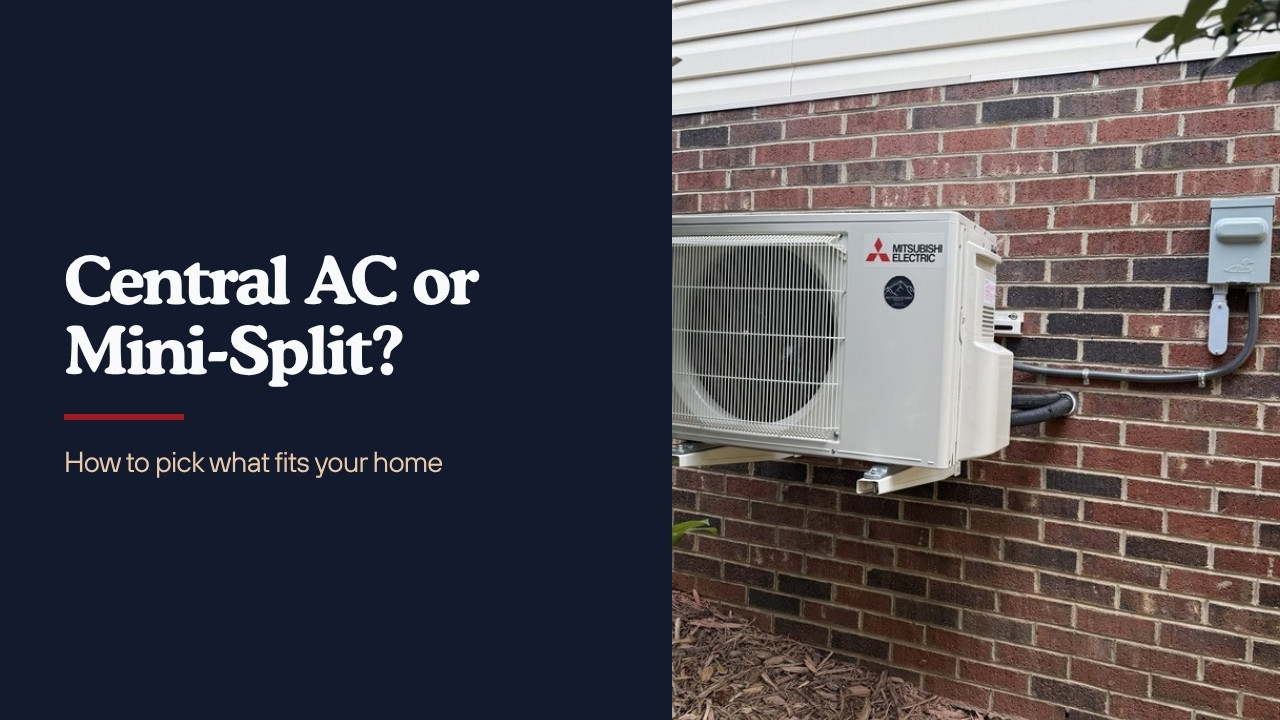
If you have been shopping for air conditioning, you have probably run into two terms that sound more complicated than they are: the split system (what most people call central air) and the ductless mini-split. Both cool your house. Both come in versions that heat it too. The right one depends on your house — not on which one is trendy, and not on which one a salesman happens to have on the truck.
Here is the plain-English version of how each one works, where each one genuinely wins, and how to tell which one fits the home you actually live in.
First, some naming confusion worth clearing up
Almost every central air conditioner is technically a “split system.” That just means the equipment is split into two halves: a condenser outside and a coil inside, connected by refrigerant lines. The indoor half sits on top of your furnace or inside your air handler, and your ductwork carries the cooled air to every room.
A ductless mini-split is also a split system — same idea, outdoor unit plus indoor unit — but instead of one big indoor coil feeding ducts, it uses one or more small wall-mounted units (called heads) that cool the room they are in directly. No ducts at all.
So when you search for a “split system air conditioner,” you could land on either one. What you are really choosing between is ducted and ductless.
Where central air wins
Your house already has good ductwork. This is the big one. If your home was built with ducts and they are in decent shape, a central system uses what you already paid for. Replacing a tired central AC with another central AC is usually the simplest, most cost-effective path — and we will tell you that even though a full mini-split conversion would be a bigger job for us.
You want the equipment invisible. With central air, the only things you see are a thermostat on the wall and registers in the floor or ceiling. There is no unit hanging in the living room. For a lot of homeowners, that matters more than they expect.
Whole-house, one setting. One system conditions everything, filtered through one filter you change a few times a year. If your family keeps the whole house at one temperature anyway, zoning is a feature you would pay for and never use.
Where mini-splits win
The house has no ducts — or no room for them. Older homes around Burke, Catawba, and Caldwell counties were often built without ductwork, or with ducts that only serve part of the house. Running new ductwork through a finished home is invasive and expensive. A mini-split needs only a small hole through the wall for the lines. That is why ductless is the standard answer for older houses, additions, garages, and bonus rooms.
That one room that is never right. Every house seems to have one: the bonus room over the garage, the sunroom, the upstairs bedroom that bakes every July. A single-zone mini-split fixes that room without touching the system that handles the rest of the house.
Room-by-room control. A multi-zone mini-split lets you run the bedroom cool at night while the empty living room coasts. If your household argues about the thermostat, ductless ends the argument — everyone gets their own. We wrote a full guide on planning a multi-zone mini-split if you are weighing how many heads you would need.
No duct losses. Ducts that run through a hot attic or a vented crawlspace leak and absorb heat. A ductless head delivers its cooling directly into the room, so none of it gets lost in transit. In a house with bad ductwork, that difference shows up on the power bill.
The honest downsides of each
Nobody sells you the downsides, so here they are.
Central air: if your ducts are leaky, undersized, or poorly routed, a shiny new condenser inherits every one of those problems. The equipment is only half the system — the ducts are the other half, and they deserve a hard look before you spend money on the box outside. And if only one room is uncomfortable, replacing the whole central system rarely fixes that one room.
Mini-splits: you will see the heads on the wall — some people never stop noticing them. Each head has its own filters that you need to rinse regularly (here is what to clean yourself and what to leave to a pro). And putting a head in every room of a large home gets expensive fast; at some point, ducted equipment is simply the better tool for conditioning a whole big house at once.
Don’t forget: both of these can heat
In the North Carolina foothills, the cooling question is really a comfort-all-year question. Central systems come as heat pumps, and nearly every mini-split sold today is a heat pump too — meaning it heats in winter and cools in summer with the same equipment. If you are replacing cooling and heating at the same time, it is worth reading our comparison of furnaces and heat pumps before you decide, because the right answer may be a pairing of the two rather than either one alone.
A simple way to decide
- Good existing ductwork, whole-house comfort, equipment out of sight: central air is probably your answer.
- No ducts, an addition, a garage, or one problem room: mini-split, almost every time.
- Older home with partial ducts: often a mix — keep the central system for the main house, add a ductless zone where the ducts never reached.
- Big family, one thermostat war: multi-zone ductless is built for exactly this.
And one more honest note: if your current air conditioner is only a few years old and struggling, the answer may be a repair, not a replacement of any kind. We walked through how to make that call in our repair-or-replace guide.
What we install
We install Goodman, Ruud, and Bosch equipment — central systems and ductless — and we service every brand, whoever put it in. We are a residential, veteran-owned company serving Burke, Catawba, McDowell, Caldwell, and Rutherford counties, and we size equipment to the house in front of us, not to whatever the old unit happened to be. New equipment we install carries a 1-year labor and 10-year parts warranty.
The best way to find out which system fits your home is to have someone stand in it. Call or text us at (828) 308-0928 and we will give you a straight recommendation — even when the cheaper option is the right one.
Southern Summit HVAC is a veteran-owned heating and cooling company serving Hickory, Morganton, Lenoir, Marion, and the surrounding foothills communities. NC License #33148.
Need a hand with your system?
Southern Summit Heating & Cooling is a veteran-owned, licensed heating and cooling company (NC License #33148) based in Hickory, serving Burke, Catawba, Caldwell, McDowell and Rutherford counties. Estimates are free and you get one of us on the phone — not a call center.
Call or Text (828) 308-0928