
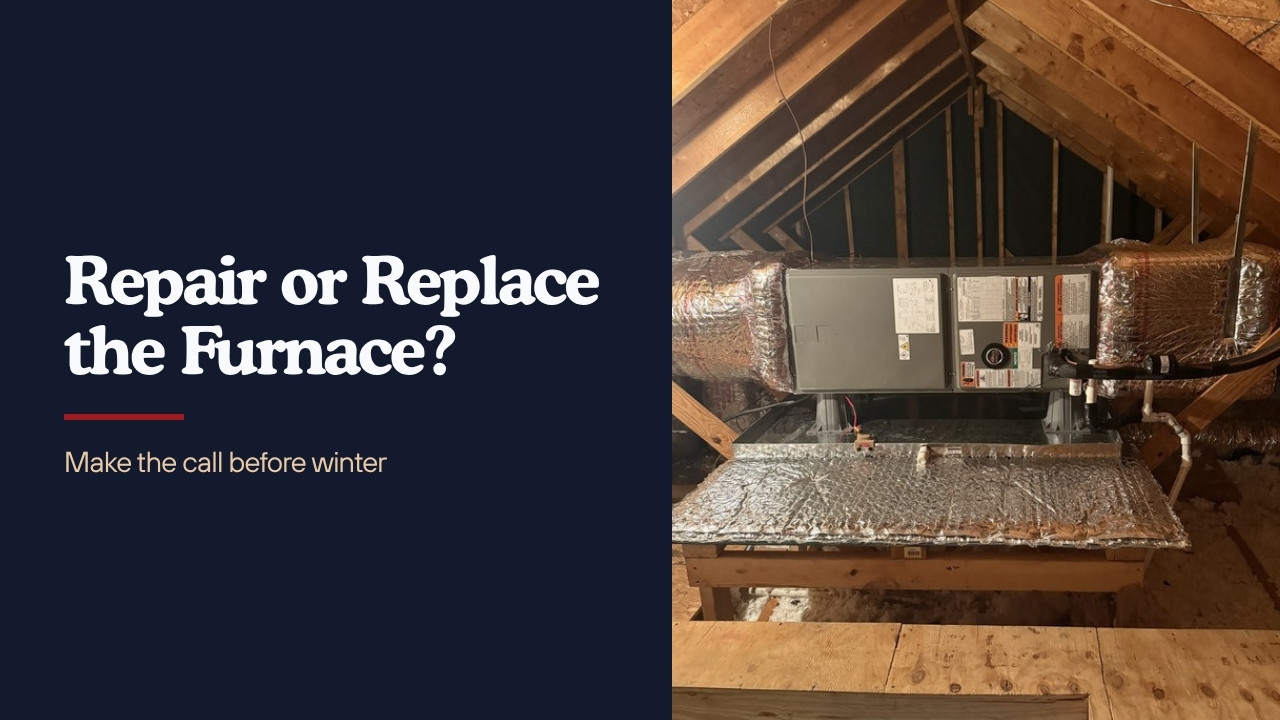
Furnaces have a talent for failing at the worst possible moment — the first hard cold snap, a holiday weekend, the coldest week of January. And a homeowner standing in a cold house is in the worst possible position to make a big decision: you will take whatever gets the heat back on fastest, whether or not it is the right call for the next ten years.
The better move is to make the repair-or-replace decision now, in the fall, while the stakes are low and you have time to think. Here is how we would walk you through it — the same logic we published for air conditioners, applied to the heating side.
When a repair is the right answer
The furnace is young. A system in its first decade with one failure is a system worth fixing. One bad part does not mean the whole unit is dying — and anyone who tells a homeowner with an eight-year-old furnace that it is “time to think about replacement” at the first hiccup is selling, not diagnosing.
The failure is small and specific. Some of the most common no-heat calls trace back to modest, well-understood parts: an ignitor, a flame sensor, a capacitor, a pressure switch. Those are honest repairs on a healthy system. If your furnace will not fire at all, run through the safe checks in our no-start guide first — a surprising number of “dead furnace” calls end at the thermostat batteries or a tripped switch.
It is the first problem, not the fifth. The pattern matters more than any single breakdown. A furnace that has needed nothing and now needs one thing is a completely different animal from a furnace you have met three technicians over.
When replacement deserves a serious look
The repairs are stacking up. When the repair calls come every season and each fix buys you months instead of years, you are no longer maintaining a furnace — you are making payments on borrowed time, without the new-equipment warranty that would come with the replacement.
The repair is major on an old unit. A big-ticket component failure — a heat exchanger, a control board and blower together — on a furnace deep into its service life is the classic replacement trigger. You would be putting your most expensive repair into the machine least likely to reward it.
The heat exchanger is cracked. This one is not a judgment call. A cracked heat exchanger can allow combustion gases, including carbon monoxide, into your home’s air. If a technician shows you a cracked exchanger, that furnace’s career is over — and it is a good moment to read our guide on carbon monoxide safety and your heating system, because every home with fuel-burning equipment should have working CO alarms regardless.
The house never feels right anymore. Rooms that heat unevenly, a system that runs constantly on cold days and still loses ground, dust and dryness that were not always there — sometimes these have fixable causes, but on an aging system they are often the sound of equipment that no longer matches the house. Our rundown of heating warning signs covers what each symptom tends to mean.
Parts are getting hard to find. For furnaces old enough, the question answers itself: when a part takes weeks to source for a machine that owes you nothing, replacement stops being a choice and becomes a schedule.
What “replace” actually means today
Twenty years ago, replacing a furnace meant buying the same thing newer. Today you have three real paths, and the right one depends on your house and how you use it:
- A new gas furnace — the familiar option, and still a strong one. Modern furnaces are meaningfully more efficient than what they replace, and gas heat keeps its punch on the coldest mornings.
- A heat pump — one system that heats in winter and cools in summer. We compared the two honestly in furnace vs. heat pump.
- A dual-fuel system — a heat pump for the mild days that make up most of a foothills winter, with a gas furnace that takes over when temperatures really drop. For a lot of homes in our area it is the best of both; here is how dual-fuel works.
We install Goodman, Ruud, and Bosch equipment across all three of those paths, and we service every brand.
What a replacement should look like — whoever does it
If you do end up replacing, a few things separate a job done right from a box swap:
- The house gets measured, not assumed. The old furnace’s size is not automatically the right size — homes get insulation, windows, and additions over the years. Proper sizing math takes the house as it is today.
- You get the recommendation in writing, with the reasoning, before any work starts. You should never feel rushed into a decision this size.
- The warranty is spelled out. New equipment we install carries a 1-year labor and 10-year parts warranty, and you should expect any installer to put their terms on paper.
Either way: maintenance changes this math
One more honest point before the decision itself. A furnace that gets looked at every fall — burners checked, flame sensor cleaned, safeties tested, filter handled — tends to reach the repair-or-replace conversation later, and in better shape, than one that only sees a technician when it quits. Neglect is what turns small, cheap failures into the big ones that force the question early. If your furnace has not been checked in a while, a fall tune-up is the single most useful thing you can do this month — and it doubles as an honest inspection, because the same visit tells you exactly where the unit stands.
And to be fair in the other direction: a two-year-old furnace does not need everything a fifteen-year-old furnace needs. If someone hands you a long list of urgent work on a young, healthy system, get a second opinion before you sign anything.
If the answer turns out to be replacement, the next step is covered in our guide to choosing and installing a new furnace.
Do this in the fall, on your schedule
Here is the part most people learn the hard way: the decision does not change between October and January, but your leverage does. In the fall, you can gather information, sleep on it, and schedule the work for a week that suits you. In January, with the house at fifty degrees, every option looks like the fast one. If your furnace is old enough or troubled enough that this article is hitting close to home, have it looked at now — run it before you need it, and find out where you stand.
We are a residential, veteran-owned company serving Burke, Catawba, McDowell, Caldwell, and Rutherford counties. We will give you the honest answer on your furnace — including “fix it, it’s fine” when that is the truth. Call or text (828) 308-0928.
Southern Summit HVAC is a veteran-owned heating and cooling company serving Hickory, Morganton, Lenoir, Marion, and the surrounding foothills communities. NC License #33148.
Need a hand with your system?
Southern Summit Heating & Cooling is a veteran-owned, licensed heating and cooling company (NC License #33148) based in Hickory, serving Burke, Catawba, Caldwell, McDowell and Rutherford counties. Estimates are free and you get one of us on the phone — not a call center.
Call or Text (828) 308-0928