
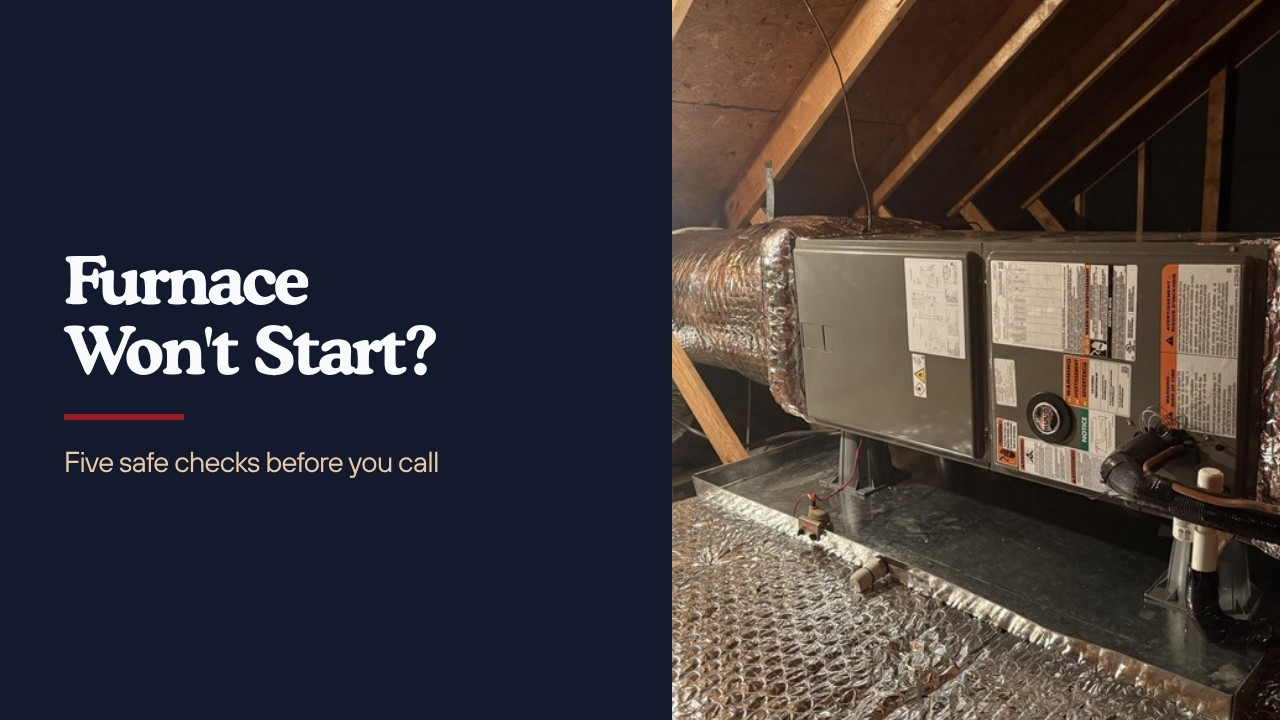
It’s the first cold morning of the season, you slide the thermostat up, and nothing happens. No whoosh, no warm air, no sound at all — or worse, a click and then silence. Before you assume the worst, know this: a meaningful share of “dead furnace” calls turn out to be something the homeowner could have fixed in two minutes, for free. We’d rather you check the free stuff first.
Here are the five safe checks, in order — and just as important, where the safe checks end.
1. Start at the thermostat
Obvious, and still the most common answer. Confirm the system is set to HEAT — not COOL, not fan-only — and push the set temperature at least five degrees above the current room reading so the system has a clear call for heat. If your thermostat runs on batteries and the screen is blank or faded, swap them. A thermostat with dying batteries can drop its connection to the furnace while looking mostly alive.
Then wait five full minutes. Many systems have built-in start delays to protect the compressor, and homeowners regularly declare a system dead during a delay it was designed to take.
2. Check the breaker — and the switch that fools everyone
Look in your electrical panel for a tripped breaker; if one’s tripped, reset it once. If it trips again, stop — a breaker that won’t stay on is protecting you from something, and resetting it repeatedly is how small problems become big ones. Leave it off and call.
Also: near your indoor unit there’s a plain light switch that controls power to the furnace or air handler. It looks exactly like a closet light switch, and it gets flipped off by painters, guests, and curious kids all the time. If your system is in a closet, attic or crawlspace, make sure that switch is on.
3. Check the filter
A filter clogged solid doesn’t just reduce airflow — it can overheat the furnace until a safety limit shuts everything down. Some systems then lock out and refuse to restart until they’ve cooled. If your filter looks like gray felt, change it, give the system twenty minutes, and try again. If you can’t remember when you last changed it, that’s your answer to whether it needs changing.
4. Open the vents and give it air
Check that supply vents around the house are open and not buried under rugs or furniture, and that the return grille — the big one that pulls air in — isn’t blocked by a couch or a Christmas tree box. Systems need to breathe on both ends.
5. Heat pump? Check one more setting
If your system is a heat pump, look for an EM HEAT or emergency-heat setting on the thermostat. If someone switched it on last winter and it stayed on, the system runs entirely on backup heat strips — it may still heat, but weakly on some systems and expensively on all of them. For normal operation it should be on HEAT, with emergency heat reserved for actual emergencies.
Where the safe checks end
That’s the whole list. Everything past this point — equipment panels, ignition components, wiring, gas valves, capacitors — belongs to a technician, and not because we’re protecting our turf. The inside of that cabinet holds line voltage, components that stay charged after the power is off, and on gas furnaces, combustion. There is no YouTube video worth what those can do.
Two absolute rules:
- If you smell gas — a rotten-egg smell — don’t troubleshoot anything. Leave the house, and call your gas utility from outside. Not the furnace switch, not a light switch, nothing on the way out.
- If a carbon monoxide alarm sounds, get everyone out first and call 911 from outside. CO is invisible and odorless, and the alarm is the only warning you get.
What happens when you call us
If the free checks don’t wake it up, the fix is a diagnosis, not a guess. When we come out, we find the actual failed component and tell you in plain English what it is, what it takes to fix, and whether — given the system’s age — the repair is money well spent. Sometimes it’s a small part and a short visit. When it’s bigger news, you’ll get it straight, with our recommendation based on your budget. That’s the arrangement: you’ll never need a translator, and you’ll never get talked into more furnace than you need.
No heat this morning somewhere in Hickory, Morganton, Lenoir, Marion or the surrounding counties? Run the five checks, and if it’s still cold in the house, call or text Southern Summit HVAC at (828) 308-0928 or request service online. Local, veteran-owned. NC License #33148.
Need a hand with your system?
Southern Summit Heating & Cooling is a veteran-owned, licensed heating and cooling company (NC License #33148) based in Hickory, serving Burke, Catawba, Caldwell, McDowell and Rutherford counties. Estimates are free and you get one of us on the phone — not a call center.
Call or Text (828) 308-0928