
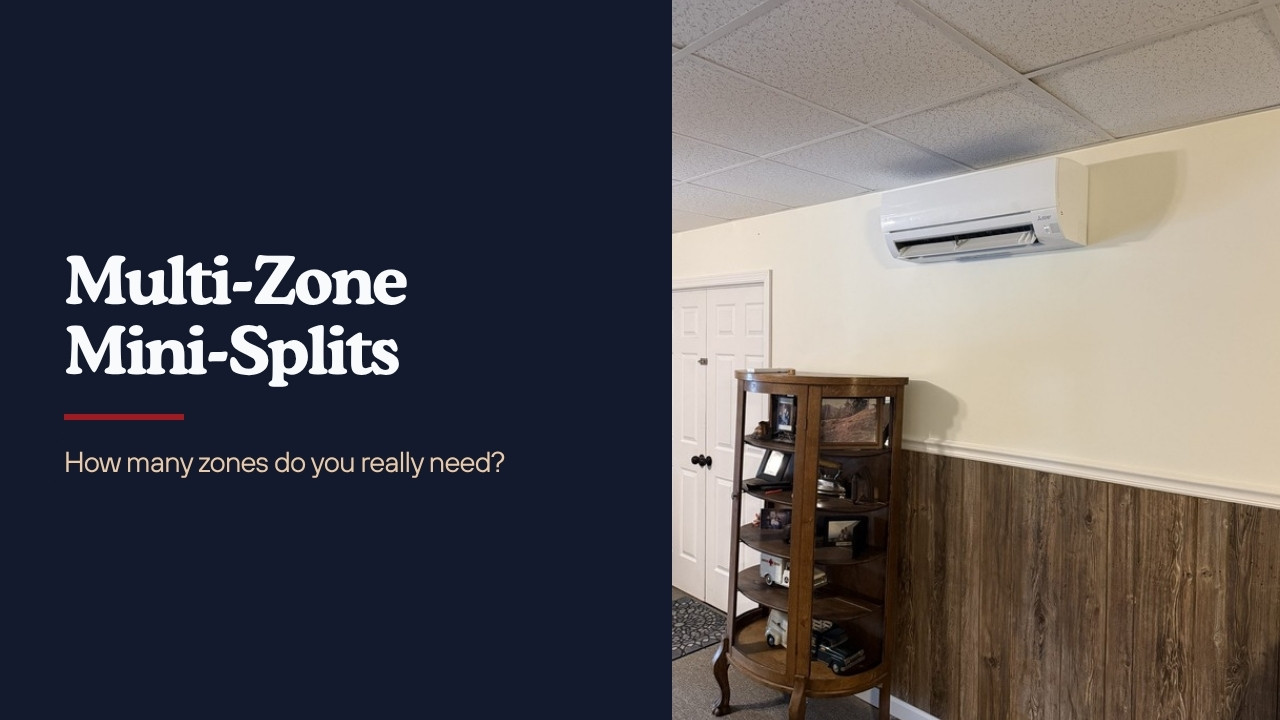
Once homeowners learn what a ductless mini-split can do, the next question is almost always the same: how many indoor units do I need? And the honest answer is: probably fewer than you think. Multi-zone systems are one of the best tools we install — and one of the easiest to overbuy. Here’s how to think about zones before anyone quotes you anything.
What a zone actually is
A mini-split system is one outdoor unit connected to one or more indoor units — the wall-mounted heads you see in each room. Each head is a zone: it has its own remote, its own temperature setting, and its own on/off. A single-zone system conditions one space. A multi-zone system runs two, three, or more heads off one outdoor unit, and each room gets its own control.
That per-room control is the whole point. The bedroom can sit at 68 for sleeping while the living room holds 72, and a room nobody’s using can be off entirely — something a central system with one thermostat can never do.
Where multi-zone earns its keep in foothills homes
The homes we see around Hickory, Morganton, Lenoir and Marion that get the most out of multi-zone systems share a pattern:
- Older homes without ductwork. Many of the area’s older houses were built around wood stoves, radiators or baseboard heat, and running new ductwork through finished walls is invasive and expensive. Mini-split heads need only a small hole for the lines — the house keeps its bones, and every floor finally gets real heating and cooling.
- Additions and bonus rooms. The room over the garage that’s never the right temperature exists in half the houses in the county. Extending ductwork to it rarely works well; a dedicated head almost always does.
- Garages and workshops. A conditioned garage in August makes a workshop usable. We’ve put heads in plenty of them.
- Upstairs/downstairs battles. Two floors, one thermostat, one argument. A head per floor ends it.
The oversizing trap — why more zones isn’t better
Here’s the part a pushy quote won’t mention. Every head you add costs money, and a head in a room that doesn’t need one is worse than wasted — an oversized system short-cycles, which means it starts and stops constantly instead of settling into the long, gentle runs where mini-splits are efficient and quiet. Short-cycling wears equipment out faster and dehumidifies worse. Bigger is not safer with these systems. Sized-right is safer.
Two questions cut through it: Does this room get used enough to condition it separately? And could one well-placed head cover this open area instead of two? An open living-dining-kitchen space usually wants one properly placed head, not three small ones. A guest room used a few weekends a year may not deserve a zone at all — and we’ll tell you so, even though it’s a smaller sale.
How sizing actually works
Each zone gets sized to its space: the room’s square footage, ceiling height, insulation, windows, sun exposure, and what’s above and below it. Then the outdoor unit gets sized to the realistic combined load — not just the sum of every head running flat-out, because in a real house they don’t. This is arithmetic done on your actual rooms. When someone quotes you a system without measuring anything, that’s the tell to get another opinion.
What placement decides
Head placement matters nearly as much as head count. A head blowing directly at a bed makes for a cold, noisy night; the same head on the adjacent wall conditions the room without you feeling the airstream. Outside, the condenser needs clear airflow and a spot where winter defrost drips won’t glaze a walkway. These are small decisions on install day and daily annoyances for the next fifteen years if they’re made carelessly.
Planning one for your house
We install ductless systems from Bosch and other major manufacturers across Burke, Catawba, Caldwell, McDowell and Rutherford counties, and we service every brand already on the wall. New installations carry a 1-year labor and 10-year parts warranty. When we walk your home, we’ll tell you which rooms genuinely need a zone, which don’t, and what we’d do if it were our own house — because the right-sized system is the one that keeps you comfortable and keeps us off your repair list.
Thinking about zones for an older home, an addition, or that one impossible room? Call or text Southern Summit HVAC at (828) 308-0928, or request a visit online. Local, veteran-owned, and honest about what you don’t need. NC License #33148.
Need a hand with your system?
Southern Summit Heating & Cooling is a veteran-owned, licensed heating and cooling company (NC License #33148) based in Hickory, serving Burke, Catawba, Caldwell, McDowell and Rutherford counties. Estimates are free and you get one of us on the phone — not a call center.
Call or Text (828) 308-0928