
The first genuinely cold night in the foothills usually shows up sometime in October, and it almost never gives you a warning. One week you’re still running the air conditioner in the afternoon, and the next you wake up to 38 degrees and reach for the thermostat for the first time since March.
That’s the moment most heating problems get discovered. Not in December, when you’d expect it. In October, on the first run of the season, when the system has been sitting untouched for six months.
The good news is that almost everything that goes wrong on that first cold night is findable in September. Here’s what we check, what you can check yourself, and how to tell the difference between a system that needs a tune-up and one that needs a repair.
Turn the heat on now, while it doesn’t matter
If you only do one thing from this page, do this one.
Pick a cool morning in the next couple of weeks, set the thermostat to heat, and push the temperature up five degrees above whatever the house is sitting at. Then go stand at a vent and wait.
You’re looking for three things. Warm air within a few minutes. No new noises. No burning smell that lasts more than ten or fifteen minutes.
That last one catches people. A little dusty, singed smell on the first run of the season is normal — it’s dust that settled on the heat exchanger or the electric heat strips over the summer burning off. It should fade. If it’s still there after fifteen minutes, or it smells sharp or electrical rather than dusty, shut the system off and call somebody.
Doing this in September means that if something is wrong, you find out on a 60-degree day when you have time to deal with it. Doing it for the first time in January means you find out at 11pm with the house dropping.
What you can check yourself in twenty minutes
None of this requires tools or taking anything apart.
Change the filter. This is the single most common cause of heating problems we get called out for, and it’s the one thing every homeowner can fix. A filter that’s been in since spring is packed with whatever the summer put in the air. A clogged filter chokes airflow, which makes the system work harder, run longer, and in some cases shut itself down on a safety limit. Write the date on the edge of the new one with a marker so you know next time.
Walk the house and open the vents. Closed supply vents and returns blocked by furniture, rugs or curtains are the second most common thing we find. Closing vents in unused rooms doesn’t save money the way people expect — it throws off the airflow the system was designed around. Open them.
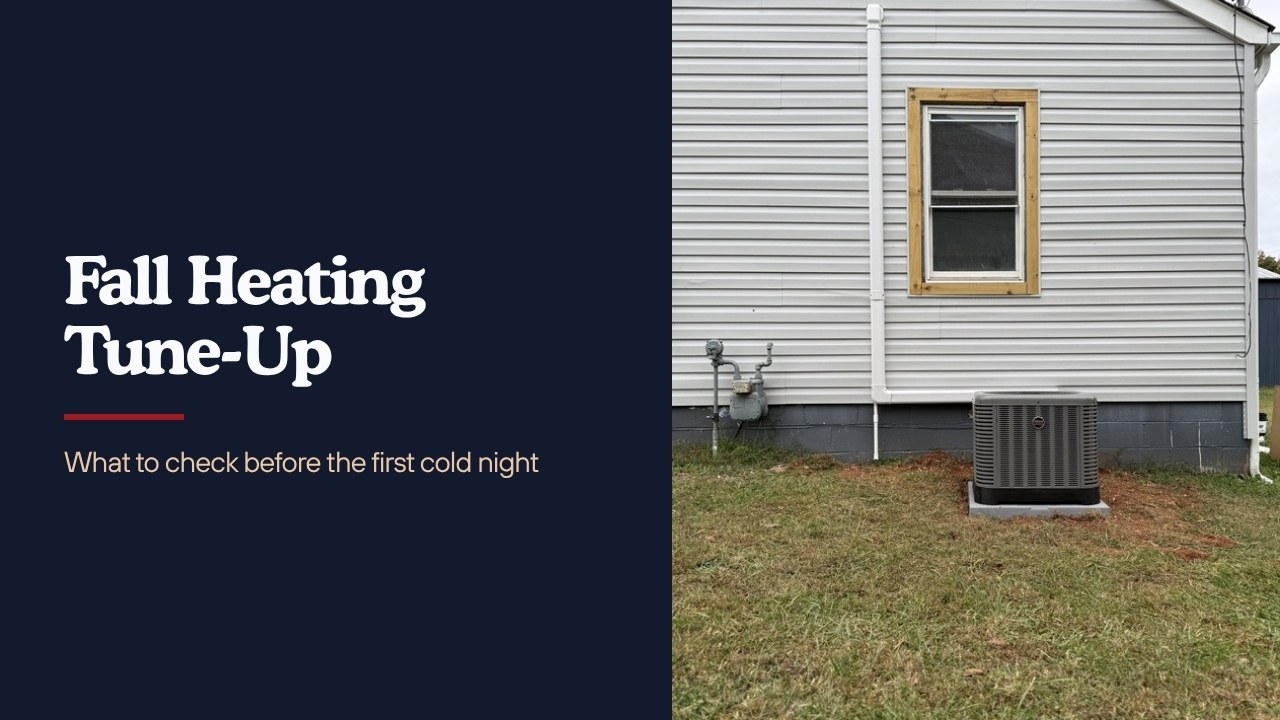
Clear around the outdoor unit. If you have a heat pump, that outdoor unit runs all winter, and it needs air moving through it. Pull leaves, grass clippings, mulch and anything else away from it, and give it about two feet of clearance on all sides. Trim back anything that grew over it during the summer.
Leave the panels alone. Everything you need to do here is on the outside of the cabinet.
Put fresh batteries in the thermostat. A thermostat with a dying battery causes symptoms that look like a dead furnace. It’s a two-minute fix that saves a service call.
Test your carbon monoxide detectors. If you heat with gas, this is not optional, and October is a good anchor date to remember it by. Press the test button on each one. Replace batteries. If a detector is more than about seven years old, replace the whole unit — the sensors expire whether the alarm chirps or not.
What we check that you can’t
A tune-up is worth having because a lot of what fails is invisible until it isn’t.
We pull and inspect the blower wheel. Dust builds up on the blades over time and quietly cuts airflow even when the filter is brand new — and it happens slowly enough that nobody notices the house getting harder to heat.
We check the electrical side: tightening connections that vibrate loose over a season, testing capacitors that are still working but reading weak, looking at contactors for pitting and burning. A capacitor that’s fading is the difference between a scheduled visit in October and a no-heat call in January.
On a heat pump we test the reversing valve and the defrost cycle, because that’s the part that only matters in winter and nobody exercises it in July. We check the auxiliary heat strips and confirm they come on when they should — and, just as important, that they aren’t coming on when they shouldn’t, which is what quietly runs up a power bill.
On a gas furnace we inspect the heat exchanger, check the flame, verify the flue is clear and drafting properly, and test the safety controls.
And we check the condensate drain, because a heat pump makes water in heating mode too, and a line that clogged over the summer will back up and shut the system down.
Tune-up or repair? How to tell
These are different visits and they cost different things, so it’s worth knowing which one you’re asking for.
A tune-up is preventive. The system works, and you want it checked over before the season.
You’re probably looking at a repair, not a tune-up, if any of these are true:
- The system runs but the house never reaches the setting
- It turns on and shuts off again within a few minutes, over and over
- You hear grinding, screeching, or a hard clunk on startup
- A breaker has tripped more than once
- Warm air comes out but only for a while, then goes cold
Any of those and it’s worth just saying so when you call. Tell us what the system is doing and we’ll tell you straight what it’s likely to be, before anybody drives out.
Not every system needs the same thing
Here’s something you don’t usually hear from an HVAC company: a two-year-old system that’s been maintained doesn’t need everything a fifteen-year-old system needs.
We look at what’s actually in front of us — the age of the equipment, what shape it’s in, how the house is set up, and how long you’re planning to stay in it. Then we tell you what we’d do if it were our house. Sometimes that’s a full service. Sometimes it’s a filter and a clean coil and we’ll see you next year.
Neal and Hunter started Southern Summit because they were tired of watching people get sold things they didn’t need. That hasn’t changed. If your system is fine, we’d rather tell you it’s fine and earn the call you make in three years when it isn’t.
Getting on the schedule
We work on every brand — Goodman, Ruud, Bosch and everything else — whether we installed it or not, across Burke, Catawba, McDowell, Caldwell and Rutherford counties. We’re a veteran-owned, residential-only company licensed in North Carolina, license #33148, and every system we install is backed by a one-year labor warranty and a ten-year parts warranty.
September and early October are the right window. Once the first hard freeze hits, everybody calls at once.
Call or text us at (828) 308-0928, tell us what you’ve got and what it’s doing, and we’ll get you on the calendar.
Need a hand with your system?
Southern Summit Heating & Cooling is a veteran-owned, licensed heating and cooling company (NC License #33148) based in Hickory, serving Burke, Catawba, Caldwell, McDowell and Rutherford counties. Estimates are free and you get one of us on the phone — not a call center.
Call or Text (828) 308-0928